Safari and adventure operators
Travellers ask AI which operator to book. We measure whether you are named.
Your website is built for people. AI assistants read it differently.
20 questions per market, 5 AI models, up to 9 languages
“Which companies run teach abroad programmes in Vietnam?”
A search engine, until recently
A customer searched, got ten blue links, and made up their own mind. You competed for position. Being fourth still meant being seen.
Riverbend Expeditions
Result 1 · example only
Northfield Travel Co.
Result 2 · example only
Kestrel Journeys
Result 3 · example only
An AI assistant, now
A customer asks, and gets one answer naming two or three companies. There is no page two. You are either in the answer or you are not in the conversation.
Riverbend Expeditions
Named in the answer
Kestrel Journeys
Named in the answer
Your company — not mentioned
Nobody scrolls past an answer. That is what makes being absent expensive now, and invisible while it happens.
Not a survey and not a sample — every provider we could find, tested the same way, in August 2026.
237
sites whose robots.txt allowed an AI crawler while the server refused it anyway — about one in seven
79%
had no llms.txt, the file AI systems increasingly look for first
1 in 3
had no structured data at all, so nothing on the page tells a machine what the business actually is
53%
scored under 70 out of 100 for AI readiness
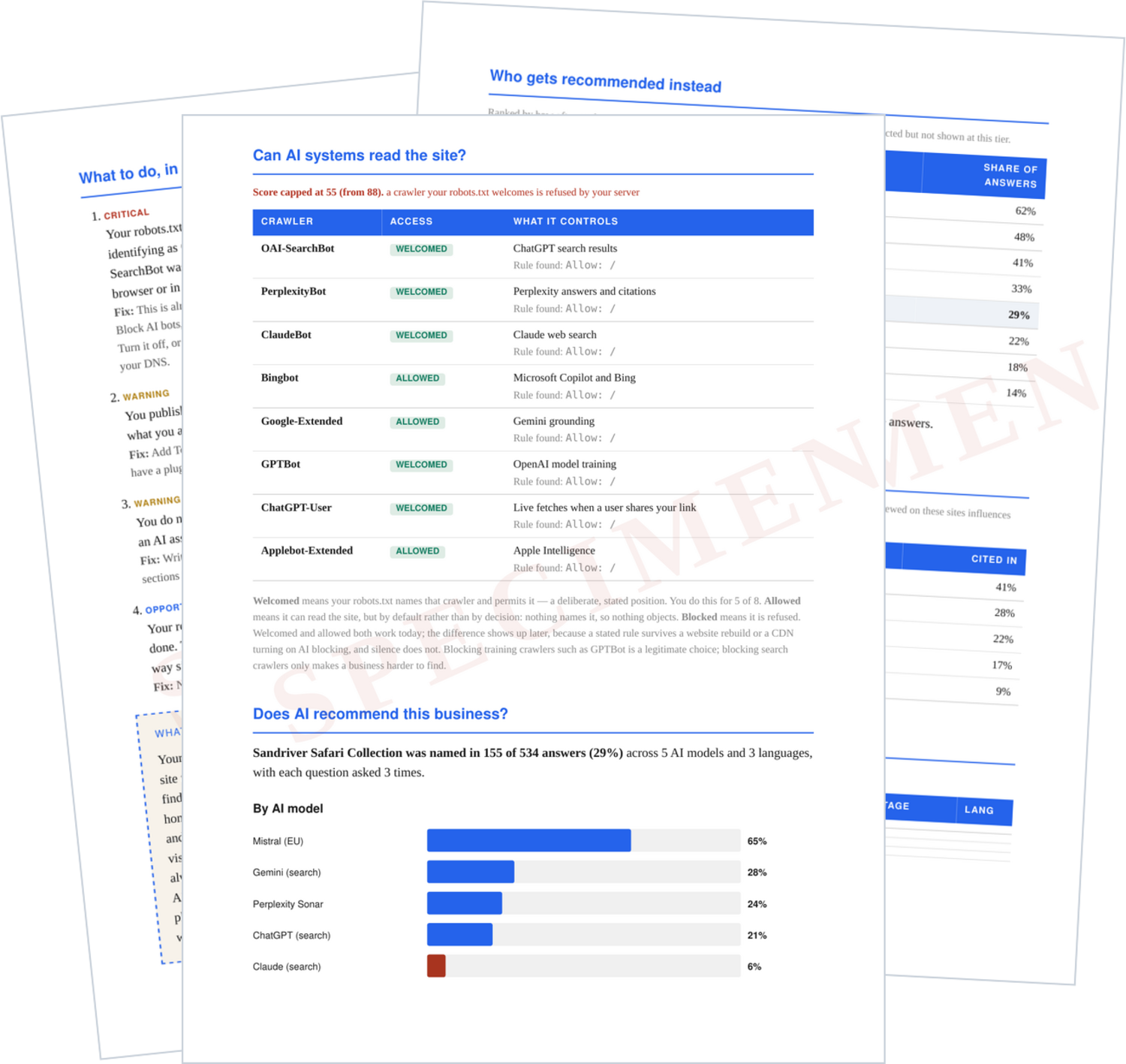
The first one is the one nobody finds on their own. A robots.txt that permits ClaudeBot means nothing if a bot rule at the CDN turns it away before it reaches your pages. The permission is public and the refusal is silent, so it does not show up in a browser, in Google Search Console, or in your analytics. We catch it by asking for your homepage as each crawler in turn and recording what your server actually does.
1,715 reachable websites audited between 18 and 20 August 2026. “Refused” counts only a server returning a hard rejection — 403 and similar — to a crawler that the site’s robots.txt did not block. Connection failures that might have been temporary are excluded.
Most AI visibility tools ask the same questions of a dentist, a law firm, and a safari operator. We keep a written library of the questions customers actually ask in YOUR NICHE — twenty of them per market, in every language your customers search in. A tool built on generalities cannot ask what a parent asks before booking a gap year, a family before their dream safari or a learner before their English course.
Travellers ask AI which operator to book. We measure whether you are named.
Students and parents ask whether your programme is legitimate. We record the answers.
We ask in nine languages, including Italian, Arabic and Turkish, in the models your students actually use.
A robots.txt file is a request. A firewall is enforcement. We check both: what your site says it allows, and what it actually does when an AI crawler asks. Those two answers disagree far more often than anyone expects, and the gap is invisible from a browser.
| publish an llms.txt — the file AI systems read to understand what a site is for | 21% |
|---|---|
| explicitly welcome AI crawlers by name | 6% |
| need JavaScript to show any text at all, so crawlers see a blank page | 6% |
More than 1,700 educational travel websites. Audited 8 August 2026.
Enter your website address and we run the technical audit on your real site — eight AI crawlers checked against your robots.txt, and ChatGPT's, Claude's and Perplexity's sent as real requests to see what your server actually does. You get your score and the single biggest thing holding you back. Only for new clients.
No account, no card.
Four out of five sites we audit have at least one fault we can name. The typical site has two or three. The free score gives you your score and the most serious one, in plain English, with the fix. The rest come with the full audit — along with the half of the picture the free score cannot see: whether AI assistants actually recommend you, and who they recommend instead. You also get a sample of typically 5 questions put to the AI models, so you can see what a subscription looks like in practice.
Monthly monitoring from $29. The technical check every month, your visibility rate tracked over time, and the competitors named instead of you.
See the plans →Or buy the one-off AI Visibility Audit — $450. A full diagnosis in one document, delivered within seven working days. →
The AI Visibility Audit is $450, and included with annual Track and Lead plans. Monitoring from $29 a month.