The 2026 benchmark
What 1,928 travel and education websites do when an AI assistant tries to read them
Signalword · Andy Woods-Ballard · Audited 2 November 2026, revised 9 and 22 November
The short version
We tried every provider we could identify across three sectors: educational travel, safari and adventure, and accredited language schools. Not a sample, and not a survey. Each site was read the way an AI assistant reads it, and each was sent real requests under the names of ChatGPT's, Claude's and Perplexity's crawlers to see what the server actually did.
1,928 sites were read successfully. The median score was 67 out of 100.
Five findings, in the order they cost a business money.
1. Almost nobody tells a machine what they sell
96.6% publish no structured data describing their product.
Structured data is the small, invisible block in a page's source that states plainly what is on offer: a price, a duration, a location, what is included. Those are the facts AI assistants most often get wrong about travel, and publishing them in a form a machine can read without inferring them from prose is the only way to state them unambiguously.
Be clear about what that does and does not buy you. Tests in late 2025 found that when an assistant fetches a page live, it reads the visible text and ignores the markup, and a 2026 study of pages that added JSON-LD found no lift in citations. Microsoft has said schema helps its models for Copilot; Google has not said its AI features use it. So the case for structured data is that it governs what the search indexes behind these assistants hold about your product, and that it keeps your prices and dates consistent everywhere they are read. It is not a direct line into a chatbot's answer, and anyone selling it as one is ahead of the evidence.
The practical consequence, which costs nothing: whatever you put in the markup should also appear in the visible text of the page. If it only exists in the markup, the assistant fetching your page today will not see it.
The failure splits in two, and the larger half is the more frustrating one.
| Share | |
|---|---|
| No structured data at all | 30.9% |
| Structured data describing the organisation but not the product | 65.7% |
| Describes the product | 3.4% |
Two in three have done the work and are getting almost none of the benefit. They
publish Organization or LocalBusiness, which tells a model the company exists.
It says nothing about what the company does for money.
Safari operators are the exception that proves it is possible: 15.1% describe their product, against 7.1% of language schools and 2.5% of educational travel providers.
2. One in six hides pages it is actively promoting
16.0% link to ten or more pages from their own homepage that are absent from their own sitemap.
A sitemap is how a crawler learns what exists without having to discover every page by following links. A page you promote on your front door but leave out of your sitemap is not hidden, but it is relying on being stumbled upon.
Two different faults produce this, and they need opposite fixes. Either the sitemap is incomplete, usually a post type switched off in a plugin, or the page is gone and the link is stale. The second is worse, because visitors are clicking it too.
Ten is the threshold we use, and it is deliberately conservative. Most sites are missing at least one page, but the median site is missing four, which is untidiness rather than a fault worth a business's attention.
3. 113 sitemaps point at a child file that will not load
5.9% of sites run a sitemap index that references a child sitemap returning an error.
This is the cleanest finding in the study and needs no interpretation. The index says "the rest of my pages are listed over there", and over there is nothing. Whole sections of those sites are invisible to anything that relies on the sitemap, and nothing on the site says so.
4. Five in six have never made a decision about AI at all
84.1% name no AI crawler in robots.txt, in either direction.
Not blocked, not welcomed. Readable because nothing objects, rather than because anything permits. That works until the day a platform default changes.
76.9% publish no llms.txt. We measure this and do not score it. Adoption by the major AI vendors is not confirmed, and every other item in this benchmark is one we can name a consequence for. It costs twenty minutes and it cannot hurt. It is not the thing to fix first, anyone presenting it as essential is overstating it, and in November we stopped awarding points for it for exactly that reason.
5. One in nine has bot rules nobody has reviewed
11.2% publish a robots.txt permitting an AI crawler, and then refuse a request that arrives under that crawler's name.
This finding used to sit at the top of this document, and it has moved to the bottom because we went back and checked what it actually costs. The answer is: much less than we first said.
We re-asked every refusal by hand, in the assistant whose crawler had been turned away. Of 253 sites, 231 opened normally — 91%. For Claude, where we checked all 195, it was 183. For ChatGPT, 48 of 58.
The reason is that firewalls verify a crawler by its network address as well as the name in its user-agent string. The real crawler arrives from a published, verified range and is let through. A request carrying the right name from an unrecognised address is refused. Our prober is the second kind, and so is anybody else's.
So the accurate claim is narrow. These sites are not invisible. They are running bot protection that nobody has reviewed, and which currently stops only the impersonators it is designed to stop. It becomes a real problem on the day a vendor changes its address ranges, or a newer assistant arrives without an established one, and nothing on the site will say so when it does.
| Share | |
|---|---|
| Safari and adventure | 15.1% |
| Educational travel | 11.5% |
| Language schools | 7.6% |
One more thing worth knowing: of the 253 sites we re-checked, exactly one refused both ChatGPT and Claude. Three that turned ChatGPT away opened for Claude; five did the reverse. There is no site in this study that is demonstrably unreachable by every assistant.
The spread
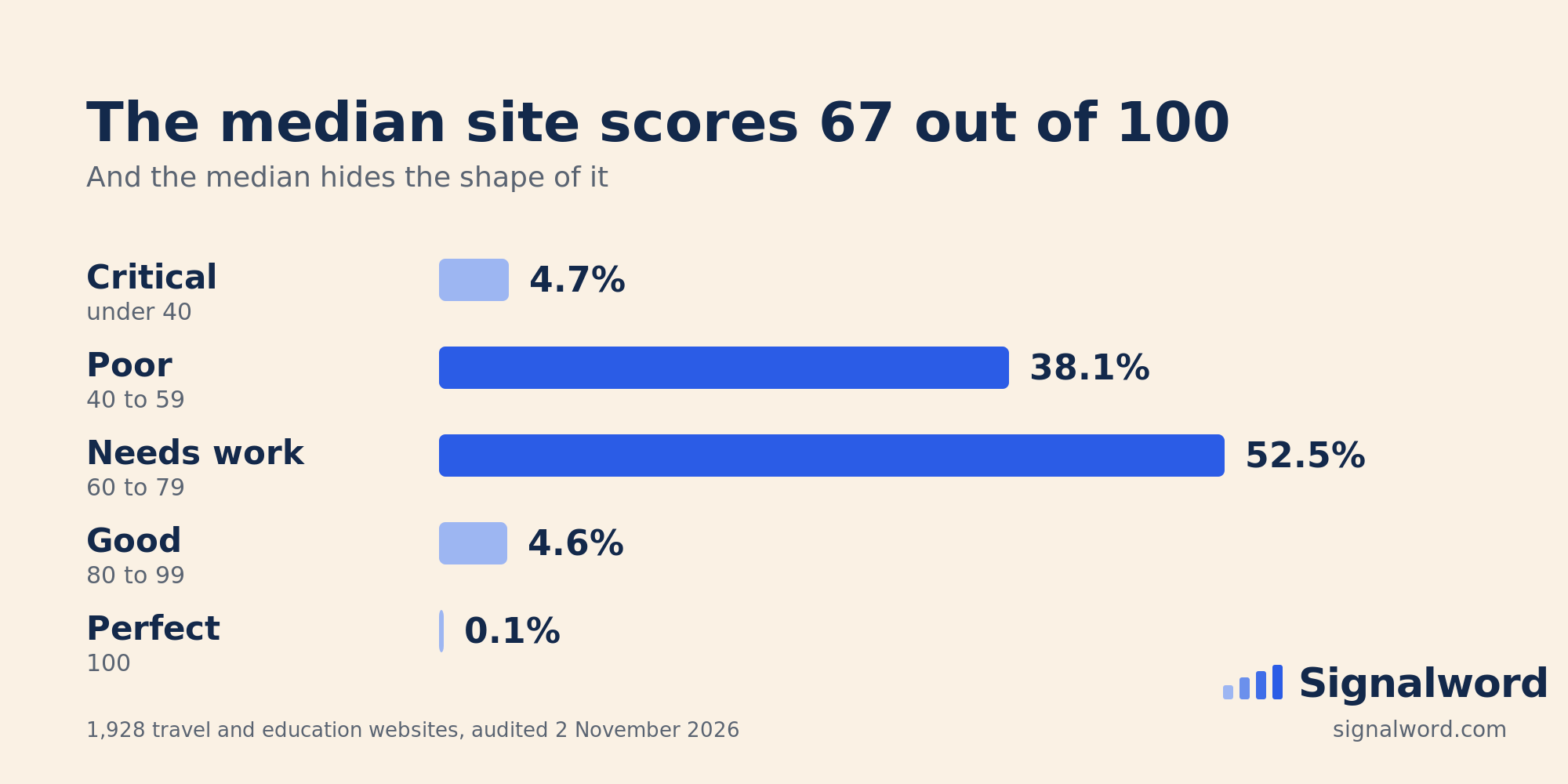
The median of 67 hides the shape of this industry.
| Sites | Share | |
|---|---|---|
| Critical, under 40 | 91 | 4.7% |
| Poor, 40 to 59 | 735 | 38.1% |
| Needs work, 60 to 79 | 1,012 | 52.5% |
| Good, 80 to 99 | 88 | 4.6% |
| Perfect, 100 | 2 | 0.1% |
Upper and lower quartiles are 76 and 54. More than half of all sites sit in a band where the basics are right and the deliberate work has not been done, which is the cheapest position to improve from.
What we did
Between 31 October and 2 November 2026 we attempted every provider we could identify in three sectors and read 1,928 of them. For each site we fetched robots.txt, llms.txt and the sitemap; followed sitemap indexes to their child files; compared the pages listed against the links on the homepage; checked the page renders without JavaScript; recorded the structured data; and sent live requests under three named AI crawlers. On 6 and 9 November we re-checked every refusal by hand inside ChatGPT and Claude.
What counts as a refusal. Only a hard rejection, 401 or 403, from a server whose robots.txt did not block that crawler. A timeout is not a refusal. A 429 means we were rate limited and proves nothing. A 404 means the page is missing. Each of those is recorded as what it is. And a refusal of our request is not evidence that the real crawler is refused, which is the point of finding 5.
What the score is. The score is out of 100 and is built from weighted checks: whether the page renders without JavaScript, whether the structured data describes the product, whether the sitemap resolves and is declared, the page basics, the crawler rules, and the depth of readable text.
llms.txt is deliberately not among them. We measure it and report it, but no AI vendor has confirmed consuming it, so it earns no score. Every other item here is one where the consequence of getting it wrong can be named.
What we did not measure, and will next time. This benchmark counts whether the facts about a product are published in structured data. It does not check whether the same facts appear in the visible text of the page. On the evidence above that is the more directly useful check, because it is the visible text an assistant reads when it fetches a page. We can compute it from page HTML already stored, so it will be in the 2027 edition. We are naming the gap rather than implying this edition covers it.
What counts as product markup. Schema types that describe the thing being sold:
Course, TouristTrip, Event, Offer, Product, EducationalOccupationalProgram,
LodgingBusiness and similar. Types that describe the business itself, Organization,
LocalBusiness, EducationalOrganization, TravelAgency, are counted separately.
What we excluded, and why. 163 records were dropped from the population before any figure here was calculated:
| Count | |
|---|---|
| Never read: the homepage did not respond, DNS failed, or the certificate was invalid | 153 |
| Expired domains now serving gambling or adult spam | 4 |
| Parked or listed for sale | 2 |
| Reviewed and found to be a different business now | 2 |
| A bot challenge page was read instead of the site | 2 |
The first row matters most and is a correction to our own earlier work. Those 153 records were inside an earlier version of this document, which claimed 2,089 sites were read successfully. They were not read at all. They scored around 15 each and supplied most of what that version reported as the "critical" band. Removing them takes that band from 10.5% to 4.6%.
Twenty-one of the 153 were excluded because something blocked our audit outright. Given finding 5, some of those are probably perfectly readable sites that refused an unrecognised client. We cannot tell, so we do not count them either way.
We also exclude category, tag, author and pagination URLs from the sitemap comparison, because leaving those out of a sitemap is a normal choice, along with infrastructure paths and checkout screens.
Multilingual sites. Sitemaps list translated pages as xhtml:link hreflang
alternates inside each entry rather than as separate <loc> records. Both are read, so
a site is credited with every page it declares in either form.
Every figure above is traceable to the stored audits and the method is published.
Sector detail
| Sites | Median | Describes product | Bot rules unreviewed | No llms.txt | No AI crawler named | |
|---|---|---|---|---|---|---|
| Educational travel | 1,665 | 67 | 2.5% | 11.5% | 76.0% | 83.4% |
| Safari and adventure | 53 | 72 | 15.1% | 15.1% | 54.7% | 84.9% |
| Language schools | 210 | 67 | 7.1% | 7.6% | 89.0% | 89.5% |
| All sectors | 1,928 | 67 | 3.4% | 11.2% | 76.9% | 84.1% |
Safari is a deliberately premium sample of 53 operators, the ones a well-researched traveller would encounter, rather than a census. Read those figures as describing those businesses.
Check your own site
The free check runs the technical half of this on your real site, by hand rather than by robot. You get your score and the single biggest thing holding you back.
signalword.com